Delivering high-resolution flood predictions for every single property across vast geographies is no small task. At 7Analytics, we rely on Kubernetes to make it possible—covering entire continents, one property at a time, in real time.
Turning Complexity into Precision
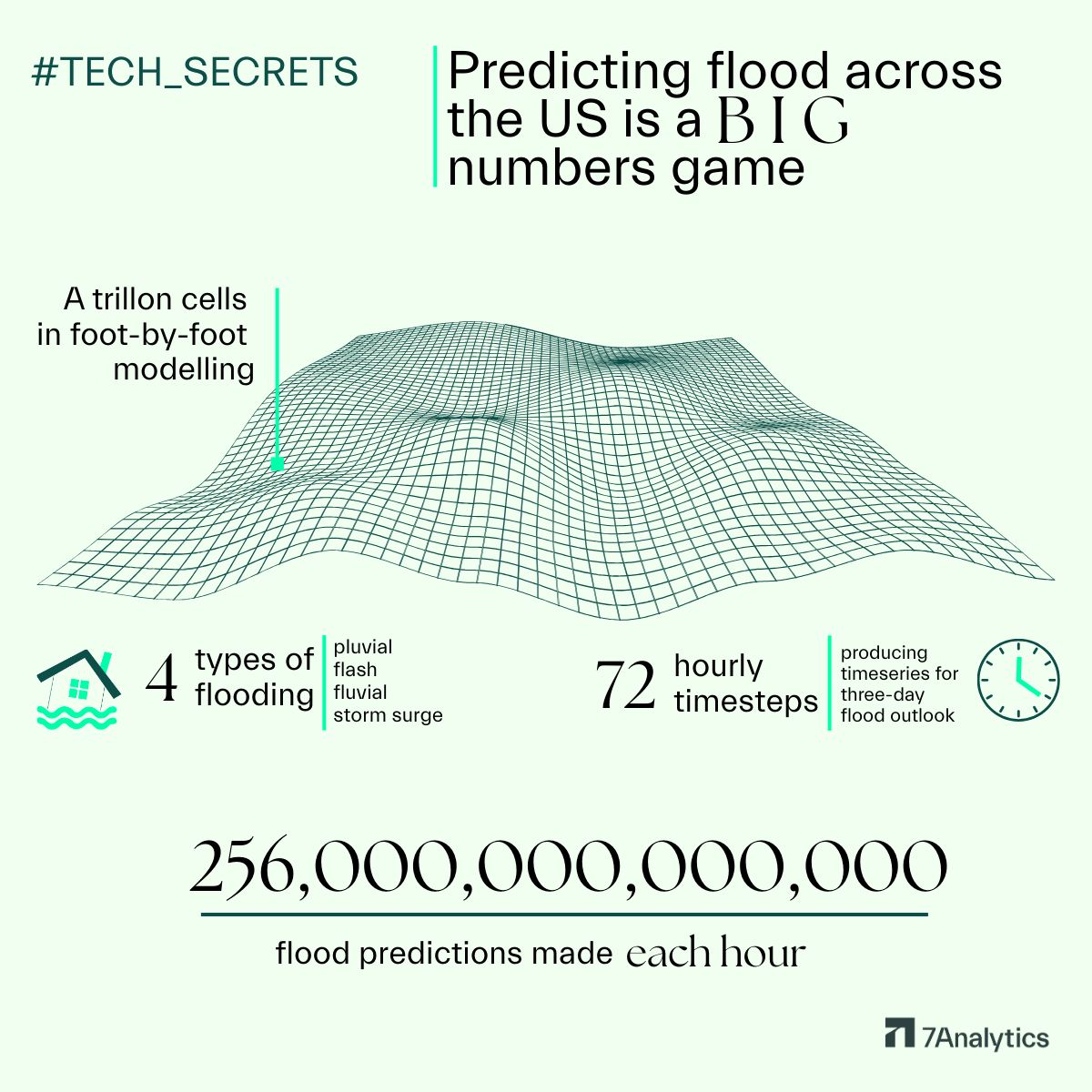
The US alone is immense, and when divided into cells smaller than half a parking lot, the computational challenge becomes staggering.
“It is a huge professional challenge to run the containerization and microservices that allow us to do high-resolution flood analytics for entire continents,” says Ilnti-Nick Pina, Kubernetes Specialist at 7Analytics.
Timely, high-resolution flood intelligence requires an elastic, resilient, and predictable platform. It must efficiently handle bursts of meteorological, hydrologic, and remote-sensing data, execute heterogeneous models within seconds, and scale resources independently. Weather events rarely unfold in straight lines: a stalled frontal boundary or a landfalling cyclone can suddenly multiply the computational demand across multiple basins.
That’s why deterministic pipelines—where identical inputs always produce traceable, auditable outputs—are central to our approach.
Four Stages of a Kubernetes-Driven Model
Our modelling framework is powered by Kubernetes across four stages:
- Data ingestion
- Preprocessing
- Model inference
- Knowledge distribution
Each stage brings unique requirements for computing, memory, I/O, and latency. Quiet periods can be followed by sharp surges when severe weather hits multiple basins. Kubernetes enables us to adapt seamlessly, ensuring that trillions of predictions are processed every hour.
Why Kubernetes Matters
Kubernetes supports our operations by:
- Workload decomposition: Each pipeline is self-contained with clear boundaries, enabling independent scaling of regions or watersheds.
- Data efficiency: Shared datasets are read once and reused across dependent workloads. Autoscaling triggers only when necessary, improving cost control, and reducing energy usage and carbon footprint.