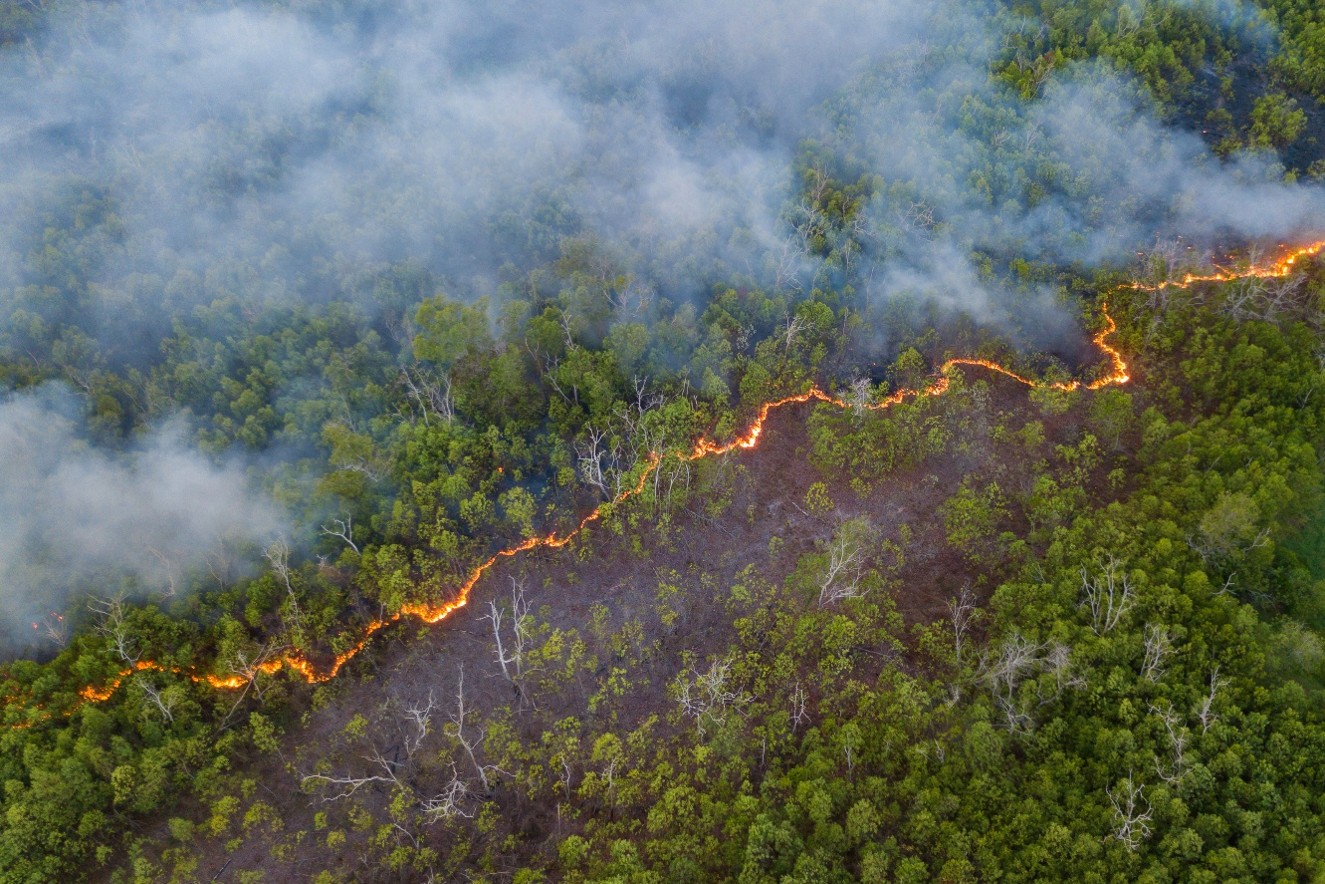
By mid-July 2026, Germany had recorded close to 10,000 heat-related deaths for the year. A record. At the same time, wildfires tore through France, Spain and Greece, forcing more than 300,000 people from their homes and burning well over 400,000 hectares. An area larger than Mallorca.
It is tempting to read these numbers as proof that Europe has become the world’s climate disaster zone. The data tells a more complicated story: one where Europe is, in some respects, less exposed than the rest of the world, and more exposed in others.
A summer of heat and fire
The heat numbers are not in dispute. In Germany 2026 is already a record, and several of its neighbours saw a similar surge in heat-related deaths during the same weeks. The wildfires that followed fit the same pattern of a hazard intensifying in a place that used to see less of it. But here the data holds a genuine surprise. The EU’s Copernicus Atmosphere Monitoring Service reported the lowest global biomass burning emissions on record during the first half of 2026.
The explanation is that global fire totals are dominated by seasonal agricultural burning across the African savanna and parts of Asia, not by the forest fires that make the news in Europe or North America. Fire isn’t disappearing. It is migrating toward places that historically didn’t plan for it, which is a different, and in some ways, more concerning problem than a simple global increase would be.
Trends like these need to be watched over longer time spans, the dynamics above are a useful illustration of why perspective matters, not a standalone conclusion. Climate change is a global phenomenon, and a narrow country, or region-level focus risks distorting the picture, not least in a year like 2026, which is shaping up to be a strong El Niño year in its own right, on top of the longer-term warming trend.
Water, not fire, is the real cost center
Wildfires dominate the news cycle, but they are not what is driving Europe’s disaster bill. Allianz Research’s July 2026 report, Europe under water, breaks down the continent’s catastrophe losses by hazard type: floods alone account for 55% of Europe’s economic losses from natural catastrophes, by far the largest share of any hazard. Wildfires, for all the coverage they receive, account for just 3.1%.
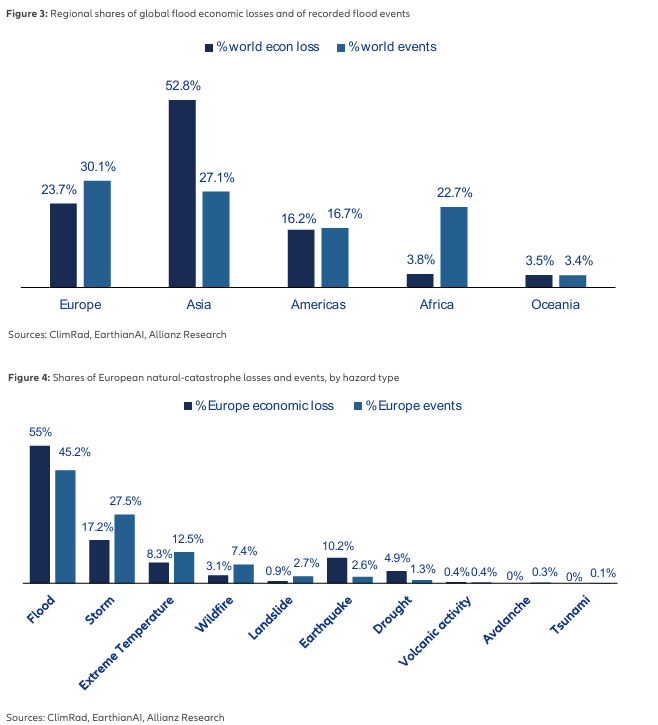
That does not mean that the current wildfires do not have very real and very significant impacts to people, businesses, and governments, as well as the environment. Further, the overall tally for 2026 might give a different story than the distribution shown above.
This does not change that floods are Europe’s costliest and most persistent natural hazard, and the trend is not encouraging. Cumulative flood damage across the continent has reached roughly €226 billion so far this century, around a quarter of global flood losses over that same 25-year period; Asia’s floods, in the same stretch of time, cost more than twice as much. Some of that increase is down to worsening weather, but Allianz points to a bigger factor: growing exposure. “As urbanisation and economic activity continue to concentrate in flood-prone areas, similar flood events destroy substantially more capital than they did two decades ago.”
So is Europe really the world’s worst-hit continent?
Here the picture shifts. Munich Re’s global disaster tally for 2025 puts Europe’s overall catastrophe losses at around $11 billion, compared with $133 billion in the Americas alone, driven by the Los Angeles wildfires and a brutal US storm season. Measured in raw economic damage, Europe isn’t close to the world’s hardest-hit continent.
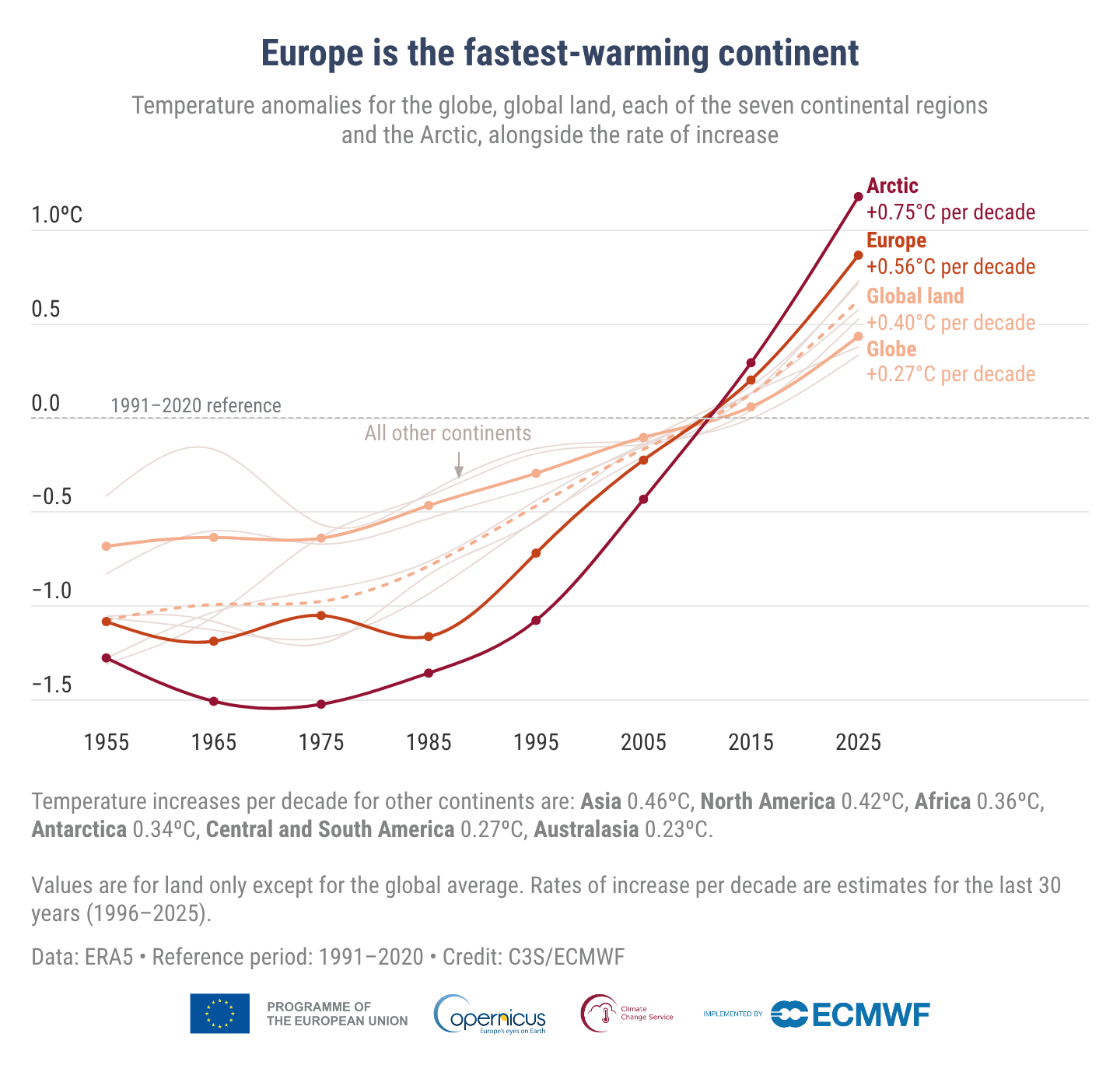
None of this means Europe’s disasters aren’t real or aren’t worsening. It means the premise “Europe suffers the most” doesn’t survive contact with the global data. What is true, and worth explaining, is that Europe is being hit hard relative to what it was built for. Part of the answer is physical. Europe is warming at roughly 0.56°C per decade since the mid-1990s, more than double the global average. Some of this is simple physics: land heats up faster than ocean.. A more surprising factor is Europe’s own clean-air progress: cleaner air means less pollution to block sunlight, and pollution had been quietly masking some of the greenhouse-driven warming underneath.
The rest of the answer is structural, and it’s where Europe’s specific vulnerability really lives. Only about one in five European homes has air conditioning, against roughly nine in ten in the United StatesAdd a population that is aging fast, Europe’s over-75 group has grown by roughly 40% in two decades, plus dense, historic city centres that trap warmth and towns built close to flammable landscape, and a modest rise in average temperature turns into an outsized rise in harm. Floods follow a similar logic: cities have paved over wetlands and floodplains that once soaked up heavy rain, and drainage systems in many places haven’t kept pace with how much water now falls in a single storm.
A closing thought
Taken together, the numbers argue for a more precise story than “Europe is burning”: a continent warming unusually fast, built for a climate it no longer has, with an aging population and a housing stock ill-suited to the heat it now sees. The same mismatch shows up in adaptation, flood-resilience investment is estimated to return roughly four times its cost in avoided damage, yet spending keeps lagging well behind the risk. The real question isn’t whether Europe is the world’s worst-off continent, it isn’t, but why a continent with this much wealth and data has been so slow to close that gap.